Welcome back to the CyberPrep.ai blog, your source for staying ahead of the ever-evolving cyber threat landscape.
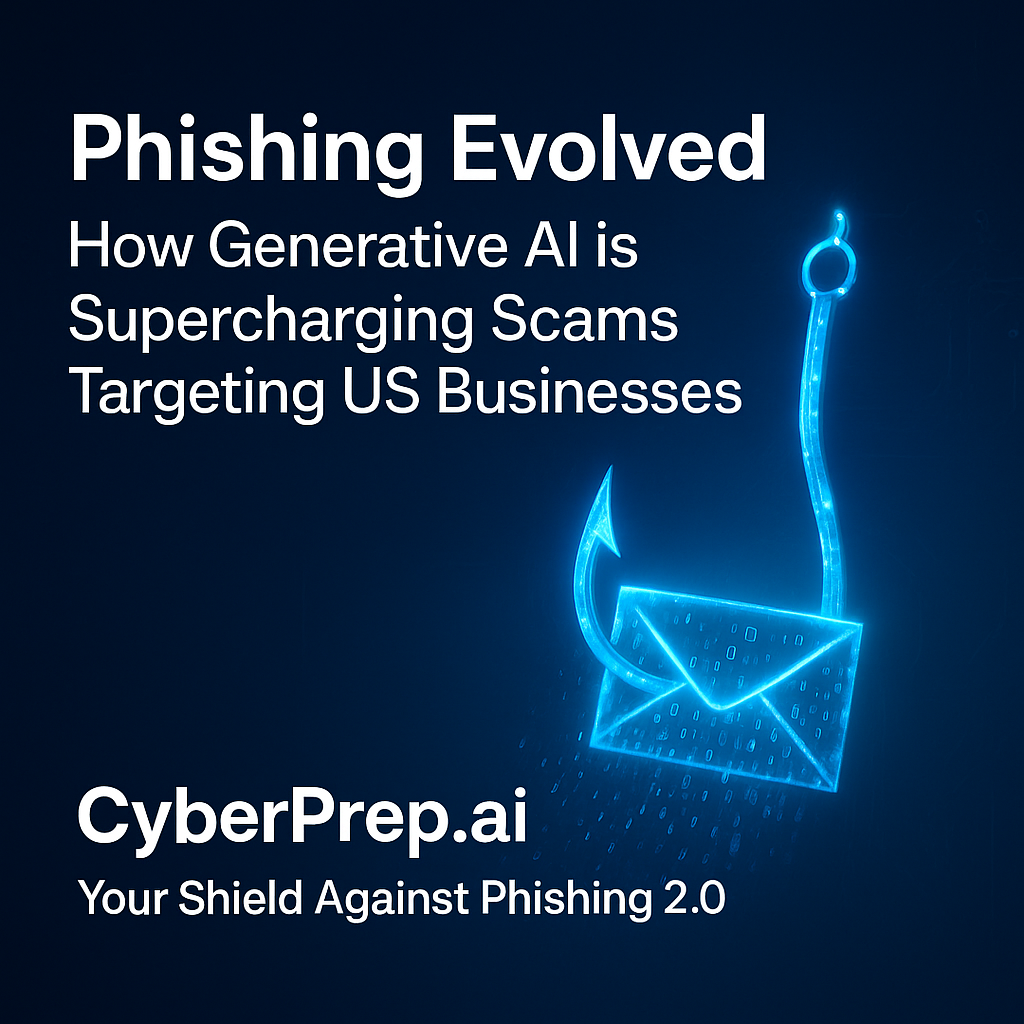
Phishing is no longer about broken English, awkward phrasing, or suspicious email addresses. In 2025, Generative AI has transformed phishing into Phishing 2.0, a sophisticated, hyper-personalized threat that can deceive even the most security-aware professionals in the United States.
For US businesses embracing digital transformation, understanding this evolution isn’t just smart security practice; it’s essential for survival.
What Is Phishing 2.0? The Generative AI Game Changer
Traditional phishing was a volume game: badly written emails blasted out to thousands, hoping someone would click. Phishing 2.0 is different. It’s precision-engineered. Here’s how:
- Perfect English, Every Time
Generative AI produces emails with flawless grammar, spelling, and tone, eliminating the classic red flags employees once relied on. - Deep Personalization with Local Context
By scraping LinkedIn, company websites, and even local industry news, AI can generate emails that reference specific projects, team members, or current events relevant to your organization. It’s no longer “Dear User”, it’s “Hi Emily, following up on the Q3 marketing initiatives you discussed with Sarah last week…” - Seamless Conversation Simulation
AI phishing tools can now mimic ongoing email threads, making them appear as legitimate follow-ups or internal communications. This drastically increases the likelihood of clicks or data sharing.
This is more than an upgrade; it’s a fundamental shift in social engineering, stripping away the familiar cues US employees once used to spot scams.
Why Traditional Security Awareness Training Fails Against AI Phishing
Telling employees to “look for typos” or “check for odd grammar” is outdated advice in the AI era. Legacy training programs are simply not enough.
Today, what matters most is not how a message is written but why it’s asking for a specific actionespecially when that action involves clicking a link, transferring funds, or sharing sensitive information.
This calls for a new mindset in US businesses:
- Critical evaluation of digital communications
- Verification-first culture (“trust but verify”)
- Scenario-based training against AI-crafted threats
Without this, organizations risk leaving their workforce dangerously underprepared.
The CyberPrep.ai Advantage: Preparing US Teams for AI-Powered Threats
You can’t defend against AI-driven attacks with outdated playbooks. The strongest defense for American businesses is a well-informed, critically thinking workforce.
That’s where CyberPrep.ai comes in. Our training programs are designed to:
- Simulate realistic AI-powered phishing attacks
- Teach employees how to detect subtle manipulation tactics
- Foster a culture of critical verification over blind trust
- Transform employees from easy targets into your first line of cyber defense
Phishing 2.0 is here, and it’s only getting more advanced. The question is whether your organization is ready to face it head-on.
Final Takeaway
Generative AI has made phishing smarter, faster, and harder to detect. For US businesses, this is not just another cyber risk; it’s a boardroom-level challenge.
Don’t let your workforce be the weak link. Prepare them for the realities of AI-powered scams today and the threats that are coming tomorrow.
Visit CyberPrep.ai to explore our US-focused, AI-aware training solutions and strengthen your team against Phishing 2.0.