There is a dangerous myth that rookie IT admins believe: “We moved to the cloud, so now security is Amazon/Microsoft’s problem.”
This belief is the #1 cause of cloud data breaches.
Just because your data is in the cloud doesn’t mean you can fire your security team. It just means the boundaries have changed. This is defined by the Shared Responsibility Model, a framework that dictates who is responsible for what.
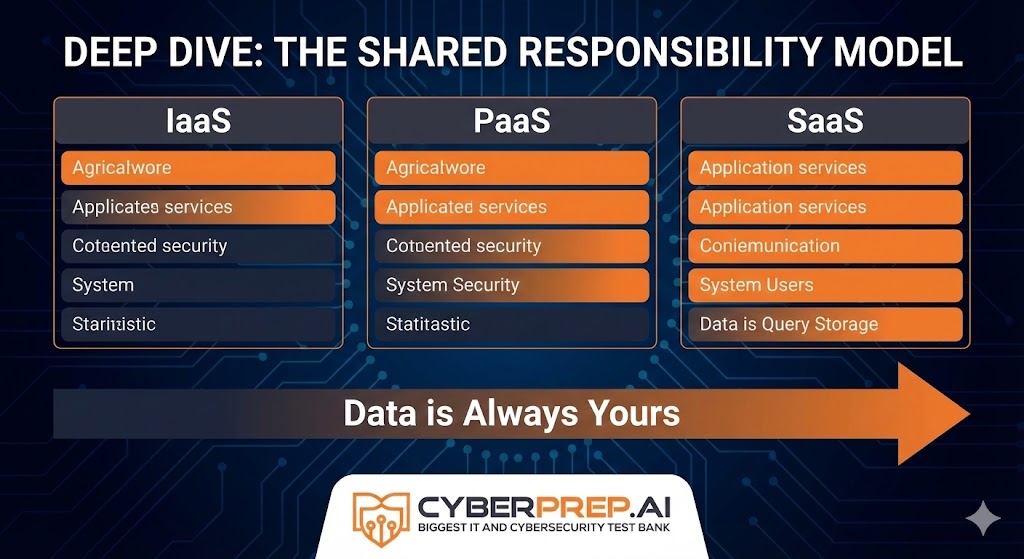
If you are studying for CompTIA Security+, CCSP, Azure (AZ-500), or AWS Security, you need to memorize this diagram.
The 3 Layers of Cloud Responsibility
To understand who fixes the breach, you have to look at the service model.
1. IaaS (Infrastructure as a Service)
- Examples: Amazon EC2, Azure Virtual Machines, Google Compute Engine.
- The Provider’s Job: They secure the Hardware. They ensure the physical data center has power, cooling, and armed guards.
- YOUR Job: Everything else. You must patch the Operating System (Windows/Linux), configure the firewall, manage the applications, and encrypt the data.
- Exam Tip: If an IaaS server gets hacked because it was running an old version of Windows, that is YOUR fault, not the provider’s.
2. PaaS (Platform as a Service)
- Examples: Azure SQL Database, AWS Elastic Beanstalk, Google App Engine.
- The Provider’s Job: They manage the Hardware AND the Operating System. They handle the Windows updates and runtime environment.
- YOUR Job: You protect the Data and the Identity (User Logins).
- Exam Tip: In PaaS, you don’t have to worry about patching the server, but you do have to worry about SQL Injection attacks against your app.
3. SaaS (Software as a Service)
- Examples: Microsoft 365 (Office), Gmail, Salesforce, Dropbox.
- The Provider’s Job: They run everything. The app, the OS, the hardware, and the network.
- YOUR Job: Data and Access.
- Exam Tip: If a user sets their password to “password123” and gets hacked, that is YOUR fault. The provider secured the platform; you failed to secure the access.
The One Constant: “Data is Always Yours”
Look closely at the model. There is one row that is always the customer’s responsibility, no matter which model you use: Information and Data.
Microsoft will never take responsibility for you uploading sensitive customer credit card numbers to a public folder. That is always on you.
Why This Matters for Your 2026 Exams
In 2026, the lines between these models are blurring, but the exam questions are precise.
You will face scenarios like:
“A company uses a PaaS solution for its database. A vulnerability is discovered in the underlying Operating System. Whose responsibility is it to patch it?”
- A) The Customer
- B) The Cloud Provider
- C) Both (Shared)
- D) The ISP
(The answer is B, because in PaaS, the provider owns the OS).
Stop Guessing. Start Practicing.
Understanding the theory is easy. Spotting the difference in a complex scenario is hard.
At CyberPrep.ai, we have built specialized question banks for:
- Cloud Certifications: Deep dives for Azure, AWS, and Google Cloud.
- CompTIA Security+: Hundreds of questions specifically on Cloud Security concepts.
Don’t let a “simple” cloud question cost you your certification.