Welcome back to Flashcard Friday! Today, we’re stripping cybersecurity back to its absolute core. Before you learn about firewalls, encryption, or hacking, you need to understand the fundamental goal of information security.
It all comes down to three letters: C-I-A.
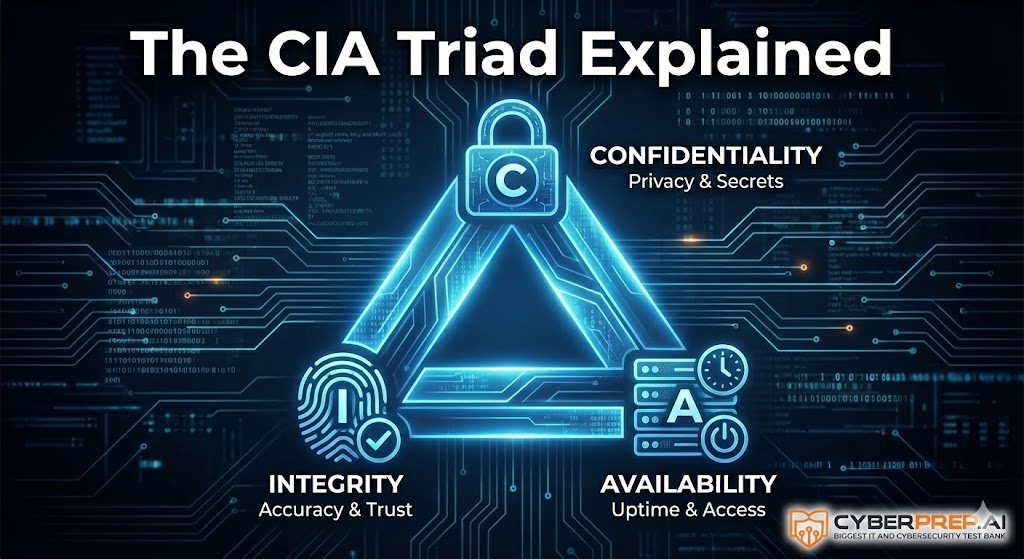
The CIA Triad is a widely recognized model that guides policies for information security within an organization. Almost every security control you will ever implement is designed to uphold one (or more) of these three principles.
Here is your 3-minute crash course to get these definitions locked into your memory for exam day.
Flashcard 1: C is for Confidentiality
- The Goal: Privacy. Keeping sensitive data a secret.
- The Definition: Ensuring that information is not accessed or disclosed to unauthorized individuals, entities, or processes.
- Real-World Example:
- Encryption: Scrambling data so that even if a hacker steals a file, they cannot read it without the decryption key.
- Access Controls: Setting permissions so that only the HR department can see employee salary data.
- The Exam Question: “A company implements full-disk encryption on all laptops. Which pillar of the CIA Triad does this primarily support?” -> Confidentiality.
Flashcard 2: I is for Integrity
- The Goal: Trustworthiness. Ensuring data has not been tampered with.
- The Definition: Maintaining the accuracy, consistency, and completeness of data over its entire lifecycle. It ensures that data cannot be modified in an unauthorized or undetected manner.
- Real-World Example:
- Hashing: Creating a unique digital fingerprint of a file. If even a single bit of the file changes, the fingerprint changes, alerting you to the tampering.
- Digital Signatures: Used to verify the authenticity of a document and prove that it hasn’t been altered since it was signed.
- The Exam Question: “You download a software update and verify its checksum before installing. What security principle are you upholding?” -> Integrity.
Flashcard 3: A is for Availability
- The Goal: Accessibility. Making sure systems work when you need them.
- The Definition: Ensuring that authorized users have reliable and timely access to information and resources when they are needed.
- Real-World Example:
- Redundancy: Having a backup server ready to take over immediately if the main server crashes.
- Backups: Regularly saving copies of data so it can be restored after a data loss event like a ransomware attack.
- Protection against DoS: Implementing systems to stop Denial-of-Service attacks that aim to flood a network and take it offline.
- The Exam Question: “A company installs a backup power generator for its data center. Which principle of the CIA Triad is this designed to protect?” -> Availability.
The Balancing Act
The challenge of cybersecurity isn’t just understanding these three concepts; it’s balancing them.
- You could make a system perfectly confidential by unplugging it from the internet and locking it in a vault, but then it would have zero availability.
- You could make a system perfectly available by removing all passwords, but then you would have zero confidentiality.
Your job as a security professional is to find the right balance for your organization’s needs.
Ready to test your knowledge? The CIA Triad is just the beginning. Head over to CyberPrep.ai to practice hundreds of scenario-based questions that will test your ability to apply these concepts in the real world.